Become the Creative Strategist of 2026: master AI ideation, scripting, avatar and AI-video production, the attention economy, and the distribution-plus-monetization playbook that turns views into dollars.
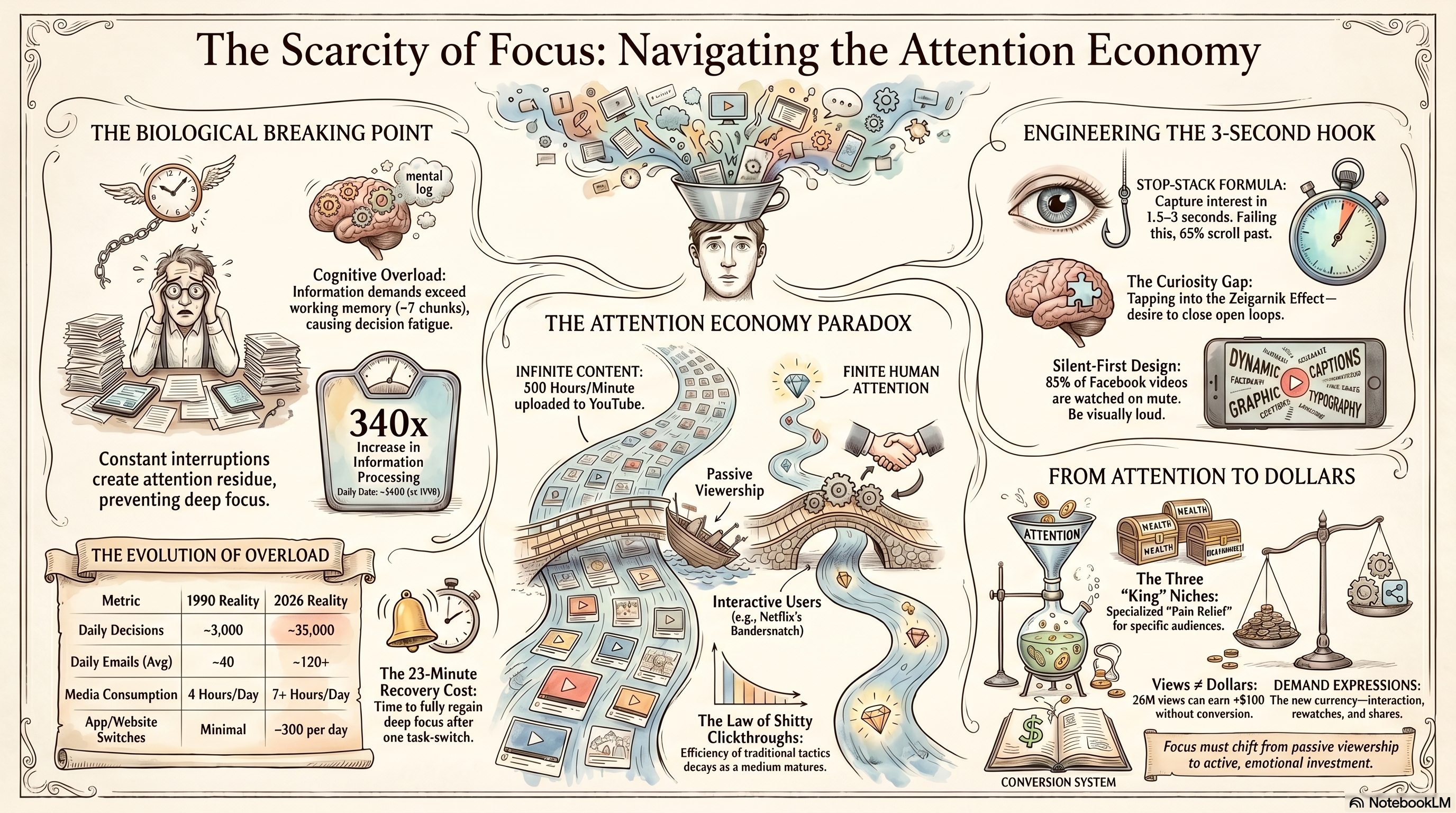
Get a free inside look at “Understanding the Attention Economy” — the module infographic and the video overview.
By the numbers
You already know video is non-negotiable — it's 82% of global internet traffic and 91% of businesses use it. But most creators and brands are stuck in the old trap: a single clip takes days, the hook falls flat, and the algorithm buries it. Discoverability is now the #1 challenge: roughly 76% of TikTok creators and 40% of YouTube Shorts creators get fewer than 1,000 views per post. The bottleneck was never effort. It was the friction of production and the science of attention — and in 2026 both of those are solvable.
AI has stripped the 'operational drag' out of filming, voiceover, editing, and design. The professional who wins in 2026 isn't the one with the best camera — it's the Creative Strategist who spends their energy on ideation and intention, then directs AI to execute. Average time to produce a 60-second marketing video has collapsed from roughly 13 days to 27 minutes, and traditional production costs of $1,000–$50,000 per finished minute now run $2–$30 per minute on AI tools. This course teaches you to operate at that altitude: concept, script, hook, render, distribute, monetize.
M1 — the new era of AI content and the rise of the Creative Strategist. M2 — building your AI video toolkit (choosing between Veo, Runway, Kling, HeyGen, Synthesia for the right shot, not the hype). M3 — creating AI videos and avatars that hold character and brand consistency across shots. M4 — producing marketing content at scale (UGC ads, hyper-personalized clips, the record-once-publish-everywhere repurposing framework). M5 — the attention economy and the six hook strategies that win System-1 attention in under 8 seconds. M6 — the Attention-to-Dollars framework that converts watch time into revenue.
Solo creators and founders who are the brand and can't afford a production team. Marketing leads and social managers who own a content calendar and a number to hit. Agencies and freelancers building an AI-video service line as demand for AI video creators surges (Fiverr reported a 66% jump in six months). And consultants who want to package this as an offer. You don't need a film background — you need a point of view and a system. We give you the system.
The creator economy is roughly $254B in 2025 and on track for ~$480B by 2027 (Goldman Sachs), with creator ad spend growing 4x faster than the total media industry (IAB 2025). 124M+ people now use AI video platforms monthly. Short-form video is ranked the #1 ROI content format by 48.6% of marketers (HubSpot 2026), and 63% of video marketers already use AI to create or edit. The creators and brands compounding right now are the ones who built the engine early. This is how you build yours.
Average time to produce a 60-second marketing video dropped from ~13 days (traditional) to ~27 minutes with AI workflows.
Traditional video production runs $1,000–$50,000 per finished minute; AI video tools bring that to roughly $2–$30 per minute on subscription plans.
6 modules, each ending in a deliverable.
Run a repeatable engine: generate ideas, write hook-first scripts, produce AI video and avatars with brand consistency, repurpose one asset into many, distribute across short-form platforms, and convert the resulting attention into revenue using the Attention-to-Dollars framework.
No. AI video tools now run roughly $2–$30 per finished minute on subscription plans versus $1,000–$50,000 traditionally. The course focuses on tool selection so you only pay for what your output volume actually needs.
The decision framework spans the 2026 leaders — Google Veo 3.1 and Runway Gen-4 for quality/hero work, Kling for high-volume social, and HeyGen/Synthesia for avatars and UGC ads — plus how to build a multi-tool stack.
Both. Short-form is the top ROI format across the board, and the course covers solo-creator workflows, brand/marketing-team workflows, and agency service-line packaging.
No. The premise of 2026 is that AI removed the production barrier. We start from the Creative Strategist mindset and build the workflow step by step; no filmmaking background required.
Module 3 covers creating avatars that hold character and brand consistency across shots, plus where audiences accept AI presenters (B2B explainers ~67%, e-learning ~71%, internal comms ~84%) and where human authenticity still wins.
Yes. Module 5 teaches the six essential hook strategies — Sneak Peek, Emotion-Trigger, FOMO, Thought-Provoking, Surprising Fact, and Problem-Solution — engineered for the ~8-second attention window and System-1 responses.
Module 6 is the Attention-to-Dollars framework: mapping watch time to leads, sales, brand deals, and AI-video service offers — closing the structural gap between view counts and revenue.
It's the 'record once, publish everywhere' system: take one core asset and spin it into dozens of platform-native clips, multiplying output without multiplying effort — the core of scaling content volume.
Only if it's generic slop. Acceptance varies by use case, and the course teaches you to deploy AI where it builds trust and keep human authenticity where it matters most, so AI amplifies your credibility rather than eroding it.
Use both deliberately. Short-form (2.5x engagement, top ROI format) is the discovery layer; long-form drives deeper income (RPMs of $1–10 vs $0.03–0.06 for Shorts). The course sequences them into one funnel.
Yes — and demand is surging (Fiverr saw a 66% jump in AI-video creator demand in six months). The course includes packaging this into an AI-video service line for clients.
It reflects the 2026 landscape — model consolidation around Veo, the rise of UGC-ad platforms, the AI-slop backlash, and current market sizes — while anchoring on durable strategy so it stays relevant as tools evolve.
Each module ships with trainer guides, strategic briefings, slide decks, study aids, and worked examples designed to be applied immediately, not just consumed.
The workflow is platform-agnostic and teaches you to produce native formats for each (optimal lengths and engagement patterns differ — e.g., TikTok ~21–34s, Reels ~60–90s, Shorts ~50–60s), so you can focus on one or run all three.
Join the Creative Strategists building repeatable viral-video engines in 2026 — and turn attention into income while everyone else is still posting and praying.